


The wood pellet machine is a key equipment for turning agricultural and forestry waste, industrial organic waste, and other waste into treasure. Its core function is to process loose waste materials into high-density pellet fuel through physical extrusion. This process may seem simple, but it actually involves multiple steps such as raw material pretreatment, mechanical extrusion molding, and physical and chemical changes. Let’s break it down step by step:
Step 1: Clarify what to “eat” – disposable waste materials
The recipe for a wood pellet machine is very extensive, and almost all organic waste containing lignocellulose can be utilized, including:
Agricultural and forestry waste: corn stalks, wheat stalks, rice husks, peanut shells, tree branches, bark, sawdust, sugarcane bagasse, cotton stalks, etc;
Processing waste: sawdust from furniture factories, scraps from paper mills, waste residue from sugarcane processing plants, traditional Chinese medicine residue, etc;
Other organic materials: some animal manure (mixed with straw to adjust ingredients), waste mushroom sticks (waste from mushroom cultivation), etc.
The common feature of these materials is that they contain cellulose (30% -50%), hemicellulose (20% -30%), and lignin (10% -25%) – these three components are the key to subsequent molding.
Step 2: “Pre meal Preparation” – Raw Material Preparation
Loose waste materials cannot be formed by directly entering the pellet machine and must first undergo pretreatment. The core goal is to make the raw materials “uniformly sized and have an appropriate moisture content”, which includes three steps:
smash
Raw materials (such as tree branches and straw) often vary in length, thickness, and fineness, and need to be crushed into uniform particles using a grinder (generally requiring a particle size of 3-5mm or less). For example, corn stalks need to be crushed into small pieces, and tree branches need to be crushed into sawdust to ensure uniform force during subsequent squeezing and avoid machine jamming.
dry
The moisture content of raw materials is a key parameter for molding (usually required between 10% -15%). If the moisture content is too high (such as fresh straw with a moisture content of over 60%), there will be “sticking” and “non molding” during extrusion; If the moisture content is too low, it will cause the raw materials to become too hard, wear down the equipment, and the particles to easily shatter.
Drying is generally done using a hot air dryer, which evaporates the moisture content of the raw materials to meet the standard through hot air (60-80 ℃).
Mixed (optional)
If the composition of a single raw material is unstable (such as low lignin content in pure straw, pure sawdust may be too hard), different materials can be mixed in proportion (such as straw+sawdust=7:3), or a small amount of biomass charcoal powder can be added to adjust the hardness and improve the molding effect.
Step 3: “Core Cooking” – Extrusion Forming (Key Action of Granulator)
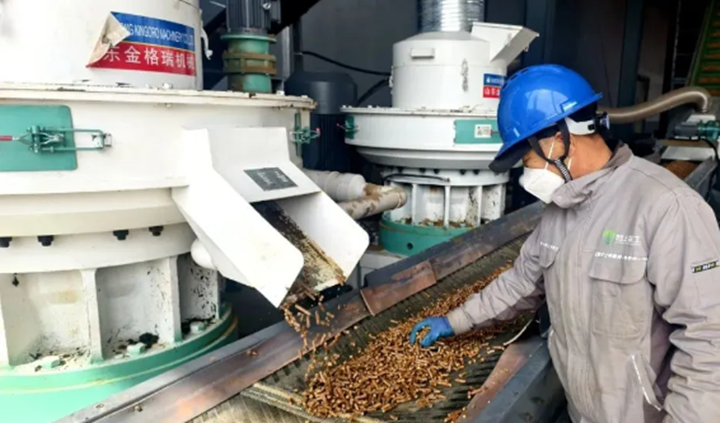
The preprocessed raw materials enter the wood pellet machine, which is the core of turning waste into treasure. The core components of a pellet machine are the “mold” and “pressure wheel”. The mainstream models are divided into ring die pellet machines (high efficiency, suitable for large-scale production) and flat die pellet machines (simple structure, suitable for small batches). The principles of the two are similar. Taking the ring die machine as an example:
Feed and Preloading
The dried and crushed raw materials enter the “granulation room” of the pellet machine through a screw conveyor, and are first compacted by a pre pressing device to reduce voids and prepare for the next step of high-pressure extrusion.
High pressure extrusion+high temperature softening
In the granulation chamber, a high-speed rotating pressure wheel (with a speed of about 300-500 revolutions per minute) squeezes the raw materials into the small holes of the ring mold (with a diameter of generally 6-12mm, determining the particle diameter). During this process, the raw materials are subjected to enormous pressure (usually 50-150MPa) and frictional heat generation, causing the temperature to rise to 100-180 ℃.
The key change here is that under high temperature and pressure, lignin (a natural binder) in the raw material will soften and melt, like a “glue” that binds cellulose, hemicellulose and other components together; At the same time, the moisture in the raw materials partially evaporates at high temperatures, further enhancing the plasticity of the materials.
Forming and cutting
The material squeezed through the small hole of the ring mold forms a continuous “rod like” shape, which is then cut by the cutting blade on the outside of the ring mold to form cylindrical particles with uniform length (usually 3-10mm) – this is the preliminary formed biomass pellet fuel.
Step 4: “Post processing” – Cooling and screening
The temperature of the particles that have just come out of the granulator is as high as 80-100 ℃, with a moisture content of about 12% -15%, and a soft texture, requiring further processing:
cooling
Use a cooling machine (similar to a combination of a fan and a conveyor belt) to lower the temperature of the particles to room temperature (20-30 ℃). At this point, the moisture in the particles will stabilize and the hardness will increase (lignin will harden again after cooling and fix its shape).
filter
Crushed particles, powders, and excessively long/short unqualified particles are removed through a vibrating screen. Qualified particles are then stored in a material bin and wait for packaging (usually in woven bags, with each bag weighing 25-50kg).
Final product: Advantages of biomass pellet fuel
After the above process, the originally loose, bulky, and difficult to transport waste materials have become:
High density: The density has been increased from 0.1-0.3 t/m ³ to 0.8-1.2 t/m ³, making it easy to store and transport;
High combustion efficiency: calorific value of about 4000-5000 kcal/kg (close to coal), with sufficient combustion and low ash content (5% -10%);
Environmental Protection: Belonging to renewable energy, CO ₂ emissions during combustion are close to “zero carbon” (the balance between CO ₂ absorbed by plants during growth and released during combustion), with almost no sulfur emissions.
Summary: The Logic from “Waste” to “Fuel”
The core logic of the wood pellet machine is to utilize the thermoplasticity of lignin (high-temperature softening, low-temperature hardening), break the loose structure of raw materials through mechanical extrusion, and allow fibers to entangle with each other and lignin to bond, ultimately forming high-density particles. The entire process does not require the addition of any chemical binders, relying solely on the physical and chemical properties of the raw materials themselves, truly achieving the goal of “turning waste into treasure”. It not only solves the problem of waste disposal, but also provides a clean alternative energy source, which is widely used in rural and agricultural fields (such as boiler heating, biomass power generation, household cooking, etc.).
Post time: Aug-19-2025


