


As the core equipment for converting straw, sawdust, agricultural and forestry waste into environmentally friendly pellet fuel, the wood pellet machine may seem simple to operate, but in fact, it hides many “secrets” that are only well-known in the industry. These details not only affect equipment efficiency and particle quality, but may also determine the success or failure of investment returns, especially for beginners who are worth paying attention to.
1、 Raw material pretreatment: It affects particle quality more than the machine itself
Many people think that ‘buying a good machine can produce good particles’, but in reality, the humidity, particle size, and impurity content of the raw materials are the key, even more important than the performance of the machine.
Humidity must be precise: Most wood pellet machines require raw material humidity between 10% -15% (with slight differences among different materials, such as wood chips at 12% -14% and straw at 10% -12%). Excessive humidity can cause loose and moldy particles; Low humidity can lead to difficulties in molding and increased mold wear. Many beginners fail by simply using wet materials on the machine without a properly equipped dryer, resulting in the particles not forming and damaging the machine.
Grinding particle size matching: The particle size of the raw material after grinding should match the mold aperture (generally requiring particle size less than 1/3 of the mold aperture). For example, when using a mold with an 8mm aperture, the raw material particles need to be less than 3mm, otherwise it is prone to material jamming and particle breakage. Straw fibers are coarse and need to be crushed finer; Wood chips are relatively loose and may be slightly coarse, but they must not have large wooden blocks or hard impurities (such as stones or metals), otherwise they will directly damage the mold.
2、 Mold: the “heart” of the granulator, but 90% of people do not understand the “compression ratio”
The mold is the core vulnerable part of the pellet machine and also a high cost component (the price of a set of molds ranges from several thousand to tens of thousands), but few people know that “compression ratio” is the soul of the mold.
Compression ratio=mold hole length ÷ hole diameter: For example, for a mold with an 8mm hole diameter and a hole length of 40mm, the compression ratio is 5:1. Different raw materials require different compression ratios.
Wood materials such as sawdust and bamboo chips: compression ratio is usually 5-6:1 (dense texture, requiring high pressure molding);
Fiber based raw materials such as straw and rice husk: compression ratio of 3-4:1 (loose texture, high compression ratio can cause particles to become hard and energy consumption to soar).
If the compression ratio is selected incorrectly, the particles will be fragile and the yield will be low, while heavy ones will cause mold blockage and motor overload and burnout. Many manufacturers recommend a “medium compression ratio” for general use, but in actual production, it must be customized according to the raw materials. This is also the key to the saying, “For machines of the same model, others have high output and good particle quality, but you cannot.
3、 The content of ‘production capacity promotion’ is high, and the actual production capacity is not equal to the theoretical production capacity
The “hourly production of 1 ton” and “hourly production of 2 tons” promoted by some manufacturers are often the ideal “theoretical production capacity” (i.e. the ideal values of meeting raw material standards, machine full load, and no downtime), but in actual production, production capacity may be reduced by 60-80% due to the following factors.
Raw material replacement, equipment cleaning, and mold maintenance will take up time (at least 1-2 hours per day);
The “feeding speed” of different raw materials varies (straw is more difficult to advance than sawdust, and slow feeding reduces production capacity);
Preheating the machine and stopping to clean the mold holes (residual raw materials may clump and require regular use of fine wire to pass through the holes) will reduce the effective production time.
When a novice purchases a machine, if the profit is calculated based on the manufacturer’s advertised production capacity, it is likely to overestimate the return. It is recommended to estimate it more reliably based on “theoretical production capacity x 70%”.
4、 The greater the power, the higher the output “is a misconception, be wary of” big horses pulling small cars “
The motor power of the pellet machine is related to its production capacity, but it is not necessarily ‘the greater the power, the better’:
The production capacity is jointly determined by the mold area, raw material characteristics, and molding pressure. For example, a pellet machine that can produce 1 ton per hour, paired with a 37kw motor, is sufficient; If a 55kw motor is forcibly used, not only will the power consumption skyrocket (spending more than ten kWh per hour), but it will also cause excessive wear and tear on the molds and pressure wheels due to “excessive power”, which will actually increase costs.
The pairing of small capacity machines with high-power motors is essentially for manufacturers to “promote good parameters”. Novices are easily misled by the saying “high power=high performance” and ignore actual energy consumption.
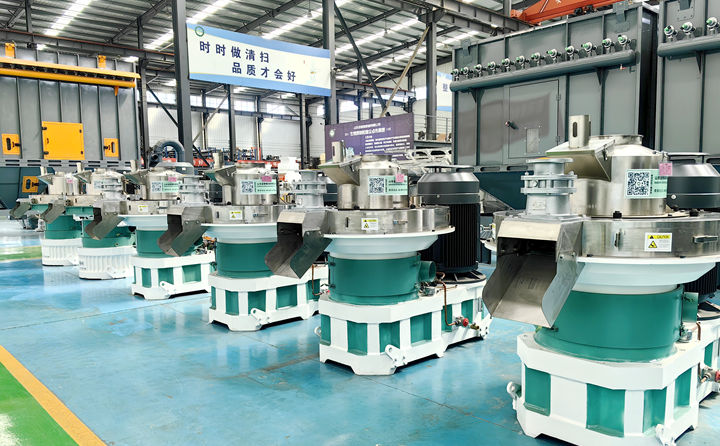
5、 ‘Free warranty’ hides traps, vulnerable parts are the ‘hidden cost’
Some manufacturers claim a “one-year warranty for the entire machine”, but it should be noted that vulnerable parts (molds, pressure wheels, cutters) are often not covered by free warranty, and these components are consumables with a high frequency of replacement:
Mold lifespan: High quality molds (such as 40Cr material quenched) can produce 50-80 tons of particles when the raw materials are clean; If there are many impurities and unstable humidity in the raw materials, 20 tons may be scrapped, and the cost of a single set of molds is several thousand to tens of thousands. Frequent replacement will thin out profits.
Roller wear: The roller comes into direct contact with the raw material and wears out faster than the mold, especially when pressing hard materials such as bark and hardwood. It may take 1-2 months to replace the roller shaft or wheel rim.
The “pit” of many low-priced machines lies in the vulnerable parts: the molds are made of ordinary cast iron (rather than wear-resistant alloy steel), and the pressure wheels are not quenched, which may seem cheap to purchase, but the cost of replacement in the later stage may be several times the price of the machine.
6、 Particle machine ≠ universal machine “, different raw materials require” targeted selection of machine type “
The wood pellet machine is divided into “flat mold machine” and “ring mold machine”, and their applicable scenarios are vastly different. Choosing the wrong model will result in you losing all your money.
Flat mold machine: simple structure, low price (several thousand to tens of thousands), suitable for small-scale production (0.1-0.5 tons per hour), but with low pressure and efficiency of the pressing wheel, it is more suitable for pressing “soft raw materials” such as straw and rice husk. The disadvantage is that the mold is prone to clogging, the output is unstable, and it is not suitable for continuous high-intensity production.
Ring molding machine: high price (tens of thousands to hundreds of thousands), high pressure, high output (0.5-5 tons per hour), suitable for “hard raw materials” such as sawdust and bamboo chips, high particle density, good molding, suitable for large-scale production. But the requirements for raw material humidity and particle size are stricter, and the maintenance cost is higher (ring molds are 3-5 times more expensive than flat molds).
A common mistake made by beginners: using a flat mold machine to process hard wood chips, resulting in loose particles and mold replacement every three days; Or buying a ring mold machine but only processing a small amount of straw, resulting in ‘overusing’ and not being able to earn back electricity bills.
7、 Dust and Safety: The Neglected ‘Lifeline’
In the production of biomass pellets, a large amount of dust is generated in the process of raw material crushing and pellet cooling, which belongs to flammable and explosive dangerous goods (when the dust concentration reaches a certain value, it may explode when encountering sparks). But many small factories, in order to save costs, do not install dust removal equipment and do not carry out explosion-proof treatment, which has buried huge safety hazards.
It is necessary to install pulse dust collectors (to collect dust), explosion-proof motors (to avoid electric sparks), and workshop ventilation systems, especially in enclosed spaces where production cannot be carried out by chance.
In addition, the friction between the mold and raw materials during the operation of the pellet machine can generate high temperatures (up to 80-100 ℃), and the cooling system (such as oil cooling and water cooling) needs to be checked regularly, otherwise it may cause a fire due to overheating.
Summary:
The ‘secret’ of the wood pellet machine is essentially that ‘details determine success or failure’ – from raw material pretreatment to mold selection, from machine model matching to safety protection, every step is more important than the ‘machine itself’. For beginners, instead of blindly pursuing “high-end equipment”, it is better to first understand the characteristics of raw materials, calculate the cost account, and come to Shandong Jingrui pellet machine manufacturer for “material testing” (on-site testing with their own raw materials), and then decide whether to invest.
Post time: Jul-22-2025


